




Tactical deep dive: How Barker’s blueprint collided with Espérance’s resilience

SIMBA SC and Espérance de Tunis played out a 2–2 draw that was far more nuanced than the scoreline suggests. The contest unfolded as a tactical chess match defined by shifting momentum, structural battles, and decisive moments inside the penalty area.
While the Msimbazi Street giants dictated the opening half with a disciplined attacking blueprint, the narrative shifted after the break. A blend of Espérance’s tactical recalibration, unforced Simba errors, and flashes of individual brilliance restored parity and ensured the spoils were shared.
This analysis deconstructs Simba’s blueprint for dominance, Espérance’s early tactical paralysis, and the second-half pivot that transformed a structured contest into a high-octane emotional battle. It explores how the match dissolved into a game of transitions, aggressive pressing, and compact defensive blocks, where the outcome ultimately hinged on fine margins.
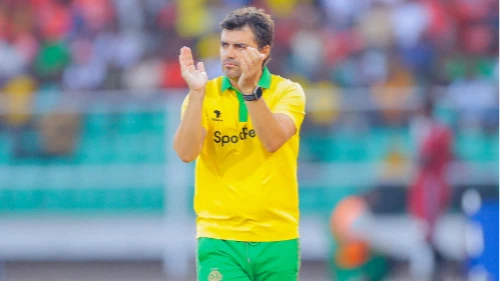
Coach Steve Barker (pictured) opted for a fluid 4-3-3 system. Djibrilla Kasalli anchored the side in goal, protected by a backline of Shomari Kapombe and Nickson Kibabage on the flanks, with Rushine De Reuck and Wilson Nangu forming the central pairing.
In midfield, Simba operated with a double pivot of Kante Allasane and Yusuph Kagoma, tasked with progressing the ball while shielding the defence during negative transitions.
Clatous Chama was granted a free role between the lines, linking midfield and attack. He supported a frontline led by Denis Kibu, flanked by Libasse Gueye on the right and Anicet Oura on the left.
Espérance de Tunis lined up in a 4-2-3-1 under Maher Kanzari. Ben Said started in goal, with Ibrahim Keita and Nidhal Laifi as full-backs, and Hamza Jelassi partnering Ben Hamida centrally. Ogbelu Onuche and Houssem Teka anchored midfield, while Abdramane Konaté operated between the lines behind striker Aboubacar Diakité. Yan Sasse and Jack Diarra occupied the wide roles.
In build-up, Simba showed clear structural planning. During low construction, they formed a 4-2-3-1 shape, with Chama dropping closer to Allasane and Kagoma to create central triangles and bypass Espérance’s first line of pressure.
As play progressed, Simba morphed into a 2-3-5. Both full-backs pushed high, but asymmetrically: Kapombe inverted into midfield while Kibabage maintained width on the left. Behind them, the two centre-backs and one pivot ensured rest-defence security against counters.
Allasane frequently dropped between the centre-backs, forming a temporary back three and allowing both full-backs to advance simultaneously. Simba circulated possession patiently, dragging Espérance’s block laterally before penetrating through wide channels.
Chama and Oura often occupied the left half-space, pulling markers inside and freeing Kibabage to attack the flank at speed.
Out of possession, Espérance defended in a compact 4-4-2 with a high line, prioritising the compression of Zone 14 and the half-spaces. Their aim was to force Simba wide and trust their centre-backs to hold position.
While this limited central access, it invited sustained Simba possession in advanced areas.
In build-up, Espérance preferred directness. Their centre-backs and goalkeeper stayed close to bait Simba’s press before releasing quickly, often toward Laifi on the left. Wingers dropped into half-spaces to receive before early crosses were delivered into the box.
In transition, Espérance relied on verticality, particularly through Jack Diarra, who served as their primary outlet.
Simba, meanwhile, adopted a compact 4-4-2 mid-block without the ball. Chama stepped up alongside Kibu to screen central access, while the wingers dropped to protect half-spaces, forcing Espérance into predictable wide circulation.
By the 35th minute, Simba had established territorial dominance inside the Tunisian side’s half.
The opening goal was a direct product of Simba’s positional patterns. Oura drifted into the left half-space, dragging his marker inside and opening space for Kibabage to advance high and wide. His low cross was repelled initially, but Simba’s box occupation proved decisive.
Kapombe, arriving late from his inverted role, saw his first effort blocked before reacting quickest to head home the loose ball in the 39th minute — a textbook example of delayed runs and numerical superiority in the area.
Persistent overloads, particularly on the right involving Chama, Allasane, Kapombe and Gueye, forced Espérance’s line to collapse inward.
Simba’s second goal followed similar logic. From a deep delivery by Nangu, Kagoma ghosted in behind the defence, completely untracked, and powered a diving header in the 45th minute from Chama’s assist. Again, it highlighted Simba’s mastery of blindside midfield runs.
The second half brought a clear change in momentum. Espérance were forced into an early adjustment when Boualia replaced the injured Jack Diarra.
The visitors began stressing width on the right, using full-back and winger combinations to stretch Simba horizontally, while also playing longer balls toward Diakité.
Simba suffered disruption when Kagoma was injured and replaced by Naby Camara in the 57th minute, unsettling their midfield balance.
Espérance’s first goal came from a breakdown in Simba’s rest-defence rather than sustained pressure. A poor back pass was intercepted by Diakité, who capitalised clinically to make it 2–1 — a reminder that transitional security can undo even organised structures.
As the game state changed, Espérance circulated possession higher up the pitch. Simba responded by retreating into a deeper block, at times forming a situational back five. Their focus shifted to compactness, recovery runs, and protection of central lanes.
Despite this, Simba still posed threats through Kibabage’s forward surges, though final decision-making blunted their impact.
The equaliser in the 78th minute arrived through individual brilliance rather than collective design. Boualia cut inside from the left, created separation at the edge of the box, and curled a sublime finish into the top corner. Simba’s compact block was breached by execution, not systemic failure.
In the closing stages, Simba alternated between high pressing and tactical fouling to disrupt rhythm. Espérance nearly completed the turnaround in stoppage time after a right-sided transition led to a penalty, but Jelassi’s miss summed up a night decided by fine margins.
Ultimately, the draw was shaped by Simba’s superior first-half structure, intelligent wide overloads, and disciplined zone control, contrasted with Espérance’s second-half adaptations and growing transitional threat.
It was a contest where planning met resilience - and where tactical dominance alone proved insufficient without sustained control across both halves.
Top Headlines
Trending Stories













© 2026 IPPMEDIA.COM. ALL RIGHTS RESERVED