




NBS: Inflation at 3.3pc, lowest across EAC core partner states

ANNUAL headline inflation for January 2026 decreased to 3.3 percent from 3.6 percent recorded in December, the National Bureau of Statistics (NBS) has stated.
In a statement released yesterday, the bureau said the decline reflects a slight deceleration in the pace of price increases for commodities in the year ending January 2026 compared to the year ending December 2025.
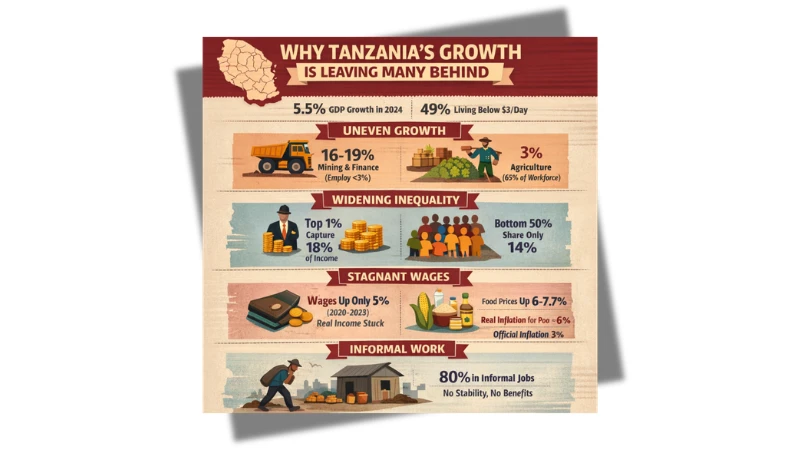
The overall consumer price index rose from 117.57 in January 2025 to 121.41 in January 2026, with food and non-alcoholic beverages inflation for January 2026 decreasing to 5.7 percent from 6.7 percent in December 2025.
Average price changes for items in the basket index excluding food and non-alcoholic beverages for January 2026 slightly decreased to 2.2 percent from 2.3 percent the previous month, it said.
The NCPI recorded relatively stable price movements from January 2025 to January 2026, fluctuating within a narrow range of 117.57 to 121.41. “Over the same period, the annual headline inflation rate remained broadly stable, fluctuating between 3.1 percent and 3.5percent,”it affirmed.
An online briefing indicates that the current consumer price index (CPI) for Tanzania is based on December 2020 prices as baseline or 100 while the average of prices for various items is based on the January to December 2020 prices data.
The commodity weights are derived from the 2017/18 household budget survey covering 383 goods and services from the 26 bureau regional headquarters on the Mainland, where the rebased index (2020=100) replaced the 2015-based index to better reflect current household consumption patterns, it stated.
In the December 2025 to January 2026 period, the national consumer price index increased from 121.11 to 121.41 due to increase of prices for some food and non-food items, the statement affirmed, pointing at food items contributing to an increase as including: rice (by 0.6 percent), finger millet grains (by 0.6 percent), maize grains (by 3.0 percent), traditionally bred live chicken (by 5.5 percent),industrially bred live chicken (by 2.3 percent), beef (by 2.1 percent) and goat meat (by 3.9 percent).
Others are poultry meat (by 0.9 percent), groundnuts (by 1.1 percent), vegetables (by 1.7 percent), Irish potatoes (by 9.4 percent), sweet potatoes (by 1.1 percent), cocoyams (by 0.6 percent), cooking bananas (by 4.3 percent) dried beans (by 0.3 percent) and cowpeas (by 2.2 percent).
Non-food items contributing to index increase included alcoholic beverages and tobacco (by 0.2 percent), actual rentals paid by tenants (by 0.5 percent), materials for the maintenance repair of the dwelling (by 0.2 percent) and charcoal (by 0.3 percent).
Others are petrol (by 0.6 percent), recreation, sport and culture (by 0.6 percent), education services (by 0.3 percent), food and beverage serving services (by 0.3 percent), accommodation services in hotels/lodges/guesthouses (by 0.4 percent) and personal care (by 0.9 percent).
In late 2025, Kenya's inflation peaked at 4.58 percent in September before settling, while Uganda's inflation saw a slight rise to 4.0 percent in September, ending the year around 3.6 percent, both countries generally seeing controlled inflation.
Uganda’s figures were often driven by food and fuel, and Kenya's by consumer goods, both scenarios remaining within or near target ranges, an online write up noted. Kenya recorded a slight reduction to 4.4 percent inflation rate for January 2026 from 4.5 percent in December, 2025 while Uganda experienced a slight increase in inflation from 3.1 percent in December, 2025 to 3.2 percent in January 2026, the statement added.
Top Headlines
Trending Stories




















© 2026 IPPMEDIA.COM. ALL RIGHTS RESERVED