




THE $19BN BLUEPRINT: Tanzania’s construction sector set for exponential decade of growth
The Tanzanian construction market is currently navigating an era of unprecedented transformation, evolving from a regional player into one of Africa’s most formidable building hubs.
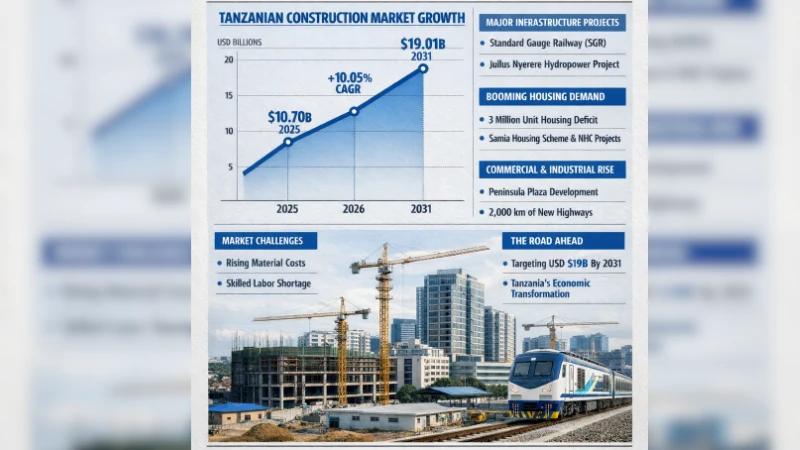
According to the comprehensive Tanzania Construction Market Size & Share Analysis - Growth Trends and Forecast (2026 - 2031) published by Mordor Intelligence, the market is expected to grow from US$10.70 billion in 2025 to US$11.78 billion in 2026.
This momentum is not a fleeting surge; it is the beginning of a sustained ascent, with the sector forecast to reach a staggering US$19.01 billion by 2031, fueled by an impressive compound annual growth rate (CAGR) of 10.05 percent over the five-year forecast period.
This robust growth trajectory is anchored by Tanzania’s successful transition into a lower-middle-income economy, a milestone that has fundamentally altered the nation's investment profile.
Today, the skyline of Dar es Salaam and the expanding corridors of Dodoma serve as tangible evidence of a reform agenda that is successfully attracting deeper pools of private capital.
For the property and investment community, these figures represent more than just economic data; they signal a profound structural metamorphosis of the nation's built environment.
At the core of this expansion is a relentless focus on flagship civil works that serve as the economy’s industrial backbone. Infrastructure projects, which accounted for approximately 38.55% of construction spending in 2025, continue to dominate order books.
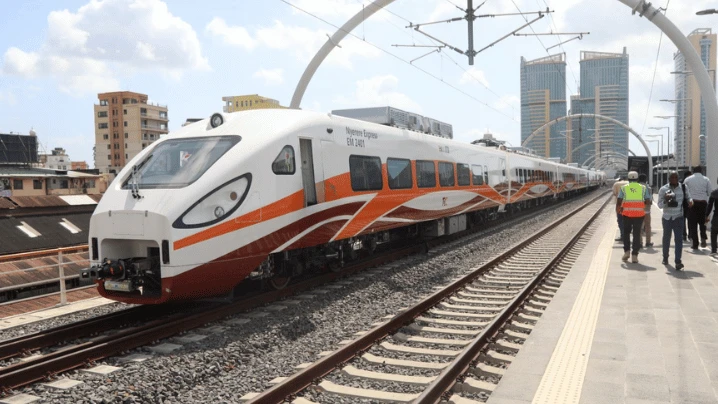
The Standard Gauge Railway (SGR)—a multi-billion-dollar project aimed at linking Dar es Salaam with landlocked neighbors like Burundi and the Democratic Republic of the Congo—is a centerpiece of this vision.
By the end of 2026, the Tabora-to-Kigoma section is expected to reach critical milestones, fundamentally reducing cargo transit costs and enhancing regional trade connectivity.
Parallel to the rail expansion is the Julius Nyerere Hydropower Project (JNHPP). As of early 2026, the project is nearly operational, with major turbines already beginning to contribute to the national grid.
The completion of this 2,115-MW facility is expected to unlock a secondary wave of construction activity.
Reliable baseload power is the primary catalyst for industrial growth, creating a positive feedback loop that requires new warehouses, factories, and ancillary logistics infrastructure across the country’s central and southern highlands.
The Residential Revolution and Urbanization
While megaprojects provide the market’s volume, the residential sector is providing its soul. Tanzania faces a national housing deficit estimated at three million units, a challenge intensified by a population that grows by over one million people annually.
Dar es Salaam, with nearly five million residents, remains the epicenter of this demand, but urbanization is no longer confined to the coast. Cities like Mbeya, Geita, and Mpanda are witnessing a surge in residential and mixed-use schemes as the national urbanization rate heads toward a projected 59 percent by 2050.
The government has responded with a series of high-impact affordable housing initiatives. The Samia Housing Scheme and projects led by the National Housing Corporation (NHC) are broadening mortgage access and stimulating institutional demand for serviced land.
Innovative financing models are also emerging, such as the rent-to-own programs managed by the pension-fund-backed Watumishi Housing Investment.
These diversified financing channels are crucial for a market where traditional mortgage penetration remains low, allowing a wider segment of the population to transition from informal self-builds to modern, planned communities.
Navigating market volatility and innovation
The path to a USD 19 billion market is not without its hurdles as The Mordor Intelligence report highlights that the industry is currently navigating significant material-price volatility.
Cement and steel prices remain sensitive to global supply-chain disruptions and regional tax-related distortions. F
Furthermore, a persistent mismatch between technical vocational training and site-level requirements has created a skilled-labor shortage in engineering and project management.
In response, the industry is embracing a new era of efficiency and localized supply chains as developers are increasingly negotiating index-linked contracts and batching orders earlier to manage cost exposure. More importantly, there is a gradual adoption of modern construction methods.
Prefabricated and modular techniques, while still a smaller segment of the overall market, are projected by analysts to grow at a faster rate than traditional on-site methods as developers seek to compress project cycles and minimize waste.
This shift toward "smart" and "green" building is also supported by new government incentives, aligning the Tanzanian market with global sustainability standards.
A new era for commercial and industrial spaces
The commercial landscape is also undergoing a tactical pivot. In Dar es Salaam, where office occupancy has hovered around 70 percent, landlords are moving away from traditional single-use office blocks in favor of flexible, mixed-use precincts.
These developments, which combine retail, co-working spaces, and luxury residential units, offer a "multi-asset risk hedge" that appeals to modern tenants.
The US$12 million Peninsula Plaza scheme serves as a blueprint for this trend, emphasizing lifestyle and community integration over mere square footage.
Simultaneously, the scale-up of transport infrastructure—including 2,000 km of planned national highways and port dredging at Lake Victoria—is strengthening the medium-to-long-term visibility for contractors.
The use of innovative market-based instruments, such as the US$58 million Samia Infrastructure Bond, reflects a growing sophistication in how Tanzania mobilizes domestic capital for public works.
The Outlook
As the nation moves toward the goals of Vision 2025 and beyond, the construction sector stands as the most visible indicator of its progress.
The transition from a US$10.70 billion market in 2025 to a forecast of nearly US$19.01 billion by 2031 signifies more than just growth; it signifies a maturing economy that is effectively bridging the gap between public ambition and private opportunity.
According to The Mordor Intelligence, Tanzania is no longer a market of the future—it is the market of the right now.
With a stable political environment, a clear legislative framework for PPPs, and an insatiable demand for both infrastructure and housing, the nation isunapologetic growth.laying the foundations for a decade of unapologetic growth.
Top Headlines
Trending Stories

















© 2026 IPPMEDIA.COM. ALL RIGHTS RESERVED