




Equity market overtakes government t debt instruments in a historic shift stock market
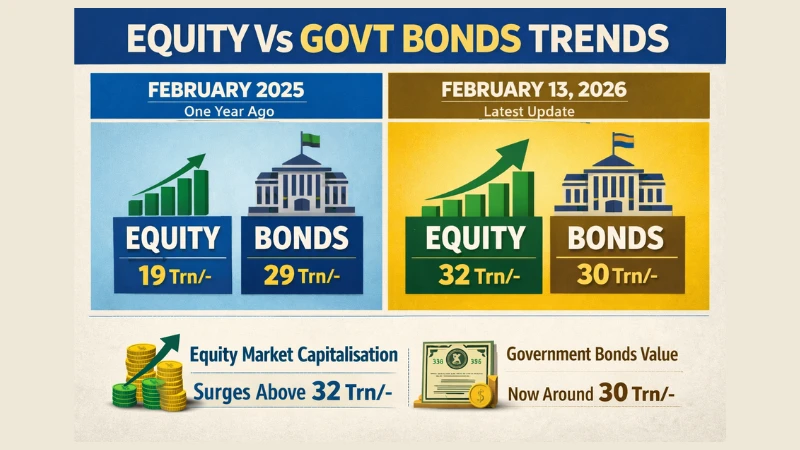
Tanzania’s equity market has overtaken the government bond segment in total market value, marking a significant structural shift in the country’s capital markets and signaling renewed investor confidence in listed companies.
Latest data from the Dar es Salaam Stock Exchange (DSE) around the February 13, 2026 trading session shows total equity market capitalisation rising above 32trn/- of which 22trn/- is domestic, surpassing the estimated outstanding listed government bond value, which stood at about 30trn/-.
One year ago, the market reports show that the government debt instruments was valued as 29trn/- compared with 19trn/- of the equity market.
The milestone represents a reversal of a long-standing pattern in which government securities dominated Tanzania’s capital market landscape.
However, sustained growth in share prices, particularly in the banking and financial services sector, has dramatically expanded equity valuations over the past year.
Strong earnings performance and improved dividend payouts by blue-chip counters such as CRDB Bank and NMB Bank and other listed local and cross listed banks, have played a central role in lifting overall market capitalisation. Increased participation by both domestic and foreign investors has further supported the rally.
Market analysts say the crossover point where equities exceed bonds in total value is more than symbolic. It reflects a deepening of Tanzania’s capital markets and growing confidence in corporate Tanzania’s growth prospects.
A senior market analyst in Dar es Salaam noted that the dominance of bonds in previous years was partly driven by high government borrowing needs and conservative asset allocation strategies by institutional investors.
“The fact that equities have now overtaken bonds suggests investors are increasingly willing to take measured risk in pursuit of higher returns. It signals maturation of the market,” he said.
Officials at the Capital Markets and Securities Authority (CMSA) have repeatedly emphasized the importance of broadening investment options and strengthening equity participation as part of long-term financial sector development.
The regulator has recently implemented reforms aimed at enhancing transparency, improving trading infrastructure and encouraging new products to the market, including ETFs.
Economists argue that a stronger equity market reduces overreliance on public debt as the primary investment vehicle within the domestic financial system.
When the bond market outweighs equities by a wide margin, capital allocation tends to favor government financing over private sector expansion.
The current shift suggests that more capital is now being channeled toward productive enterprises through share ownership.
The development could also reshape institutional portfolio strategies. Pension funds, long considered the backbone of the bond market, may gradually rebalance toward equities to capture capital gains and dividend growth, particularly as listed firms continue to post solid financial results.
Retail participation, though still modest by regional standards, has also shown signs of improvement amid rising market awareness and improved access to trading platforms.
From a macroeconomic perspective, the shift underscores confidence in Tanzania’s growth trajectory. A rising equity market often reflects expectations of expanding corporate earnings, stable macroeconomic management and supportive policy direction.
Analysts say continued stability in inflation, exchange rates and interest rates will be crucial in sustaining investor appetite for shares.
Nevertheless, experts caution that bond markets remain essential to fiscal management and long-term infrastructure financing.
Government securities provide a benchmark yield curve and serve as a critical risk-free reference for pricing corporate debt and other financial instruments.
The emergence of a larger equity market should therefore be viewed not as a weakening of bonds, but as evidence of a more balanced and diversified capital market structure.
Historically, the bond market’s dominance was understandable in an environment where few large corporates were listed and risk appetite remained subdued.
Today’s crossover reflects the combined impact of corporate profitability, market reforms and broader investor engagement.
If sustained, the trend could encourage more private companies to consider public listings, further expanding the market’s depth and liquidity.
A larger and more vibrant equity segment would enhance Tanzania’s ability to mobilize long-term capital domestically, reducing dependence on external financing and strengthening financial resilience.
Top Headlines
Trending Stories
























© 2026 IPPMEDIA.COM. ALL RIGHTS RESERVED