




Equity market records 291bn/- in seven weeks, signaling strong activity in 2026
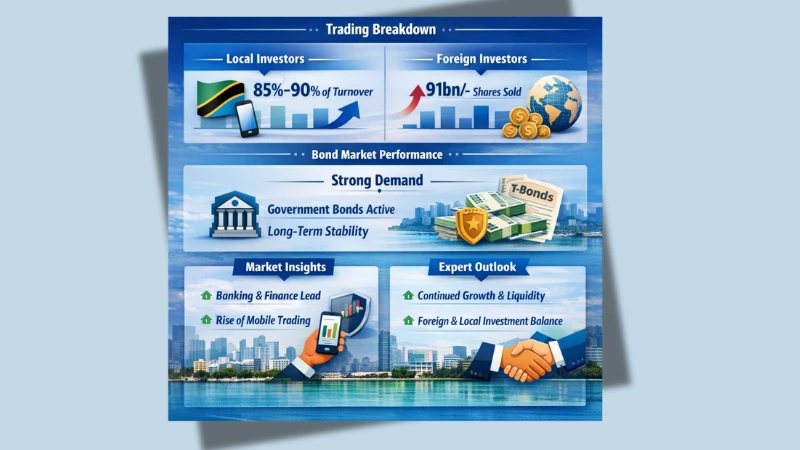
Tanzania’s equity market has started 2026 with remarkable momentum, generating a total turnover of 291bn/- in just the first seven weeks of trading.
This level of activity not only surpasses comparable periods in Q4 2025 and Q1 2025 combined but also highlights the growing depth, liquidity, and vibrancy of the country’s capital markets.
Equity trading led this surge, with banking, finance, and investment counters consistently contributing the bulk of weekly turnover.
According to the reports, the activity involved both local and foreign investors, supported by strong domestic participation and strategic block trades that pushed volumes and values higher.
Brokers report that institutional investors, collective investment schemes, and high-net-worth retail traders were particularly active, seizing early-year price movements to reposition portfolios for potential gains.
From an expert perspective, patterns emerging in early 2026 suggest deeper market liquidity, growing sophistication among participants, and the continued maturation of the Tanzanian capital market.
“Sustaining this momentum will require continued investor education, enhanced foreign participation, and robust regulatory frameworks that maintain confidence in both equity and bond markets,” noted an analyst based in Dar es Salaam.
The dominance of banking and financial counters underscores their role as market bellwethers, while retail participation via mobile platforms reflects the democratization of trading access, allowing smaller investors to engage alongside institutions.
Local investors remain the primary drivers of turnover, but foreign investors are critical for injecting capital and stabilizing prices. Their presence, though smaller, introduces international perspectives on valuations, strengthening the resilience of the market.
By the end of 2025, the Dar es Salaam Stock Exchange (DSE) had already recorded a record year in turnover and market capitalization. Equity turnover for the last quarter of 2025 amounted to 135bn/-, boosted by portfolio rebalancing ahead of the new year, though seasonal effects slightly moderated the full quarterly figures.
The 291bn/- turnover achieved in just seven weeks of Q1 2026 reflects not only a stronger pace but also more sustained activity, suggesting that liquidity is increasingly structural, supported by a growing base of active investors and the wider adoption of digital trading platforms.
Q1 2025 — Baseline for Growth
The first quarter of 2025 recorded equity turnover of 123.5bn/-, dominated by a few blue-chip counters, including Tanzania Breweries Limited (TBL) and Tanzania Cigarette Company (TCC). Local investors accounted for over 91 percent of share purchases, while foreign investors were net sellers, offloading shares valued at 59bn/- against purchases of 10bn/-.
The Q1 2026 turnover of 291bn/- represents not only numerical growth but also greater breadth in market participation, with mid-cap counters, exchange-traded funds (ETFs), and select industrial counters increasingly contributing to daily trading activity. This broader participation indicates a diversification of investment interests among Tanzanian investors, beyond the traditional blue-chip stocks.
Local vs. Foreign Participation in Q1 2026
During the first seven weeks of 2026, domestic traders accounted for approximately 85–90% of equity turnover. They purchased 98 percent of the value of transacted shares and represented 68% on the selling side. This reflects heightened engagement by both institutional and retail investors, particularly through mobile trading platforms such as the DSE’s Hisa Kiganjani, which has expanded access and democratized trading for smaller investors.
Foreign investors, while contributing a smaller share of turnover, continue to play a stabilizing role. In Q1 2026, they primarily sold shares worth 91bn/-, providing liquidity to the market while capitalizing on early-year gains. Analysts view this as a positive trend, as local investors drive daily volume and foreign flows add depth and resilience.
Bond Market Turnover and Trends
While equities drew headlines, the bond market also contributed significantly to liquidity. In the first seven weeks of 2026, government bond turnover remained strong, particularly in long-duration Treasury bonds favored by institutional investors such as pension funds, insurance companies, and corporate treasuries. Bonds provide stable fixed-income instruments that complement equity trading, and the sustained demand signals confidence in Tanzania’s regulatory environment and macroeconomic stability.
Active trading in government bonds indicates that institutional investors trust the country’s regulatory framework while seeking fixed-income returns to balance equity exposure.
The parallel growth of equity and bond trading points to a maturing capital market where investors are diversifying portfolios to balance risk and return. Analysts note that such balanced growth is critical for market resilience, helping the financial system withstand shocks while offering a broad range of investment options.
Implications for Tanzania’s Financial Market
The early performance of 2026 reflects both confidence and optimism among investors. A higher turnover suggests that the market is attracting new participants, deepening liquidity, and expanding beyond a concentration in blue-chip stocks.
The increasing participation of mid-cap counters, ETFs, and mobile retail investors indicates that Tanzanians are becoming more engaged and financially literate, while foreign flows provide stability and international benchmarks for pricing.
Analysts also point to technological adoption as a key factor in sustaining market growth. Mobile trading platforms have lowered barriers to entry, allowing more households and small investors to participate, thereby broadening the investor base. Over time, this trend could lead to greater financial inclusion and a more resilient market ecosystem.
Turnover is emerging as a key barometer of investor confidence and market health, reflecting both robust domestic engagement and complementary foreign participation.
As Tanzania’s capital markets continue to grow in size, sophistication, and accessibility, they are increasingly playing a critical role in channeling savings into productive investments and supporting economic development.
Top Headlines
Trending Stories
















© 2026 IPPMEDIA.COM. ALL RIGHTS RESERVED